
Shannon Residence
2 Shannon Ave, Merrylands — Dual Occupancy
Corner lots carry potential that many owners underestimate. The additional street frontage, the generous side setbacks, the opportunity for dual access — all of these qualities make a corner allotment one of the more flexible residential sites available for dual occupancy development in NSW. When the site at 12 Shannon Ave came to us, we recognised it immediately as an opportunity to demonstrate what thoughtful design can unlock from a modest footprint.
The site is compact. That was never a problem — it was the brief. Our task was to deliver two fully self-contained residences, each with its own street address and identity, without either home feeling like half of something. That balance between efficiency and quality is, in many ways, the central challenge of all dual occupancy work. Here, it shaped every decision we made.
The Brief
The client's requirements were clear: maximise the allowable floor area within the applicable planning controls, deliver two dwellings that would attract genuine interest in the market — whether as rental investment or owner-occupier — and do so with a facade that made no apologies for being a dual occupancy. In Western Sydney particularly, dual occ developments are often visually repetitive, builder-driven, and immediately legible as investment product. This was to be something different.
Motion 8 was engaged to design a project that would perform financially and architecturally. The two are not in opposition. A well-considered facade, the right material palette, and a building that addresses its corner site with confidence will always hold its value better than one that does not.
The Design
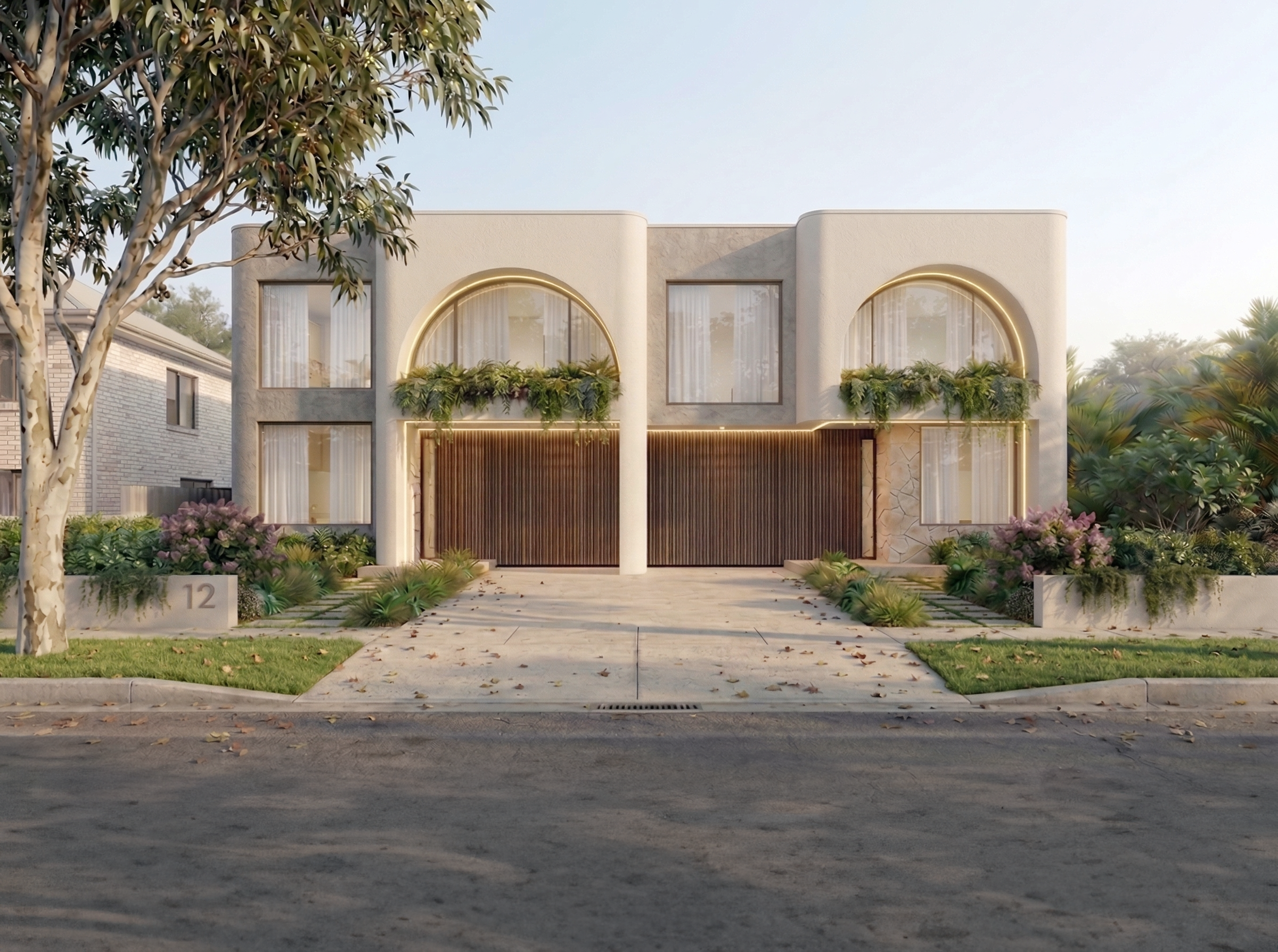
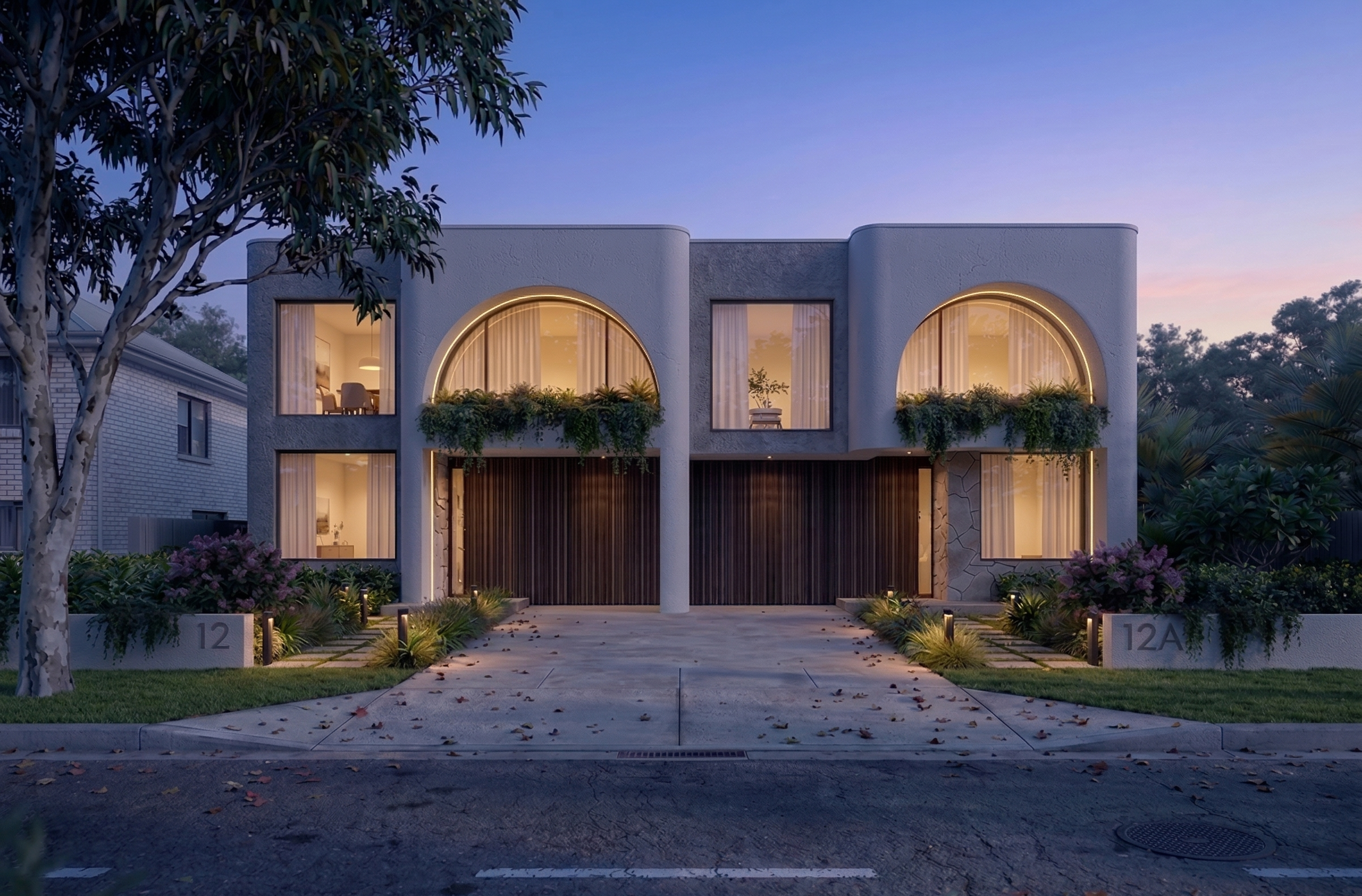
The building is two storeys, rendered in a warm off-white finish, with twin arched openings at first floor level that define the facade of each dwelling. These arches are not ornamental — they organise the glazing, frame the interiors, and give the building a scale and presence that is unusual for its type. The composition reads as a single piece of architecture from the street, with No. 12 and 12A addressed individually by masonry garden walls at each boundary, each carrying its own number plate.
The fluted timber garage doors are bespoke and wide-battened, adding warmth and texture to what is typically the most unresolved element of a residential facade. Integrated within the building footprint rather than placed as an afterthought, the garage for each dwelling is fully enclosed, contributing to the overall massing rather than subtracting from it. No site area is lost to external structures.
At first floor level, planted ledges cascade greenery along the building's face — a detail that softens the rendered mass, responds to the scale of the street, and continues to improve as the planting establishes. Linear LED cove lighting traces the underside of the first floor balcony, adding quiet presence at dusk without theatrics.
Maximising the Footprint
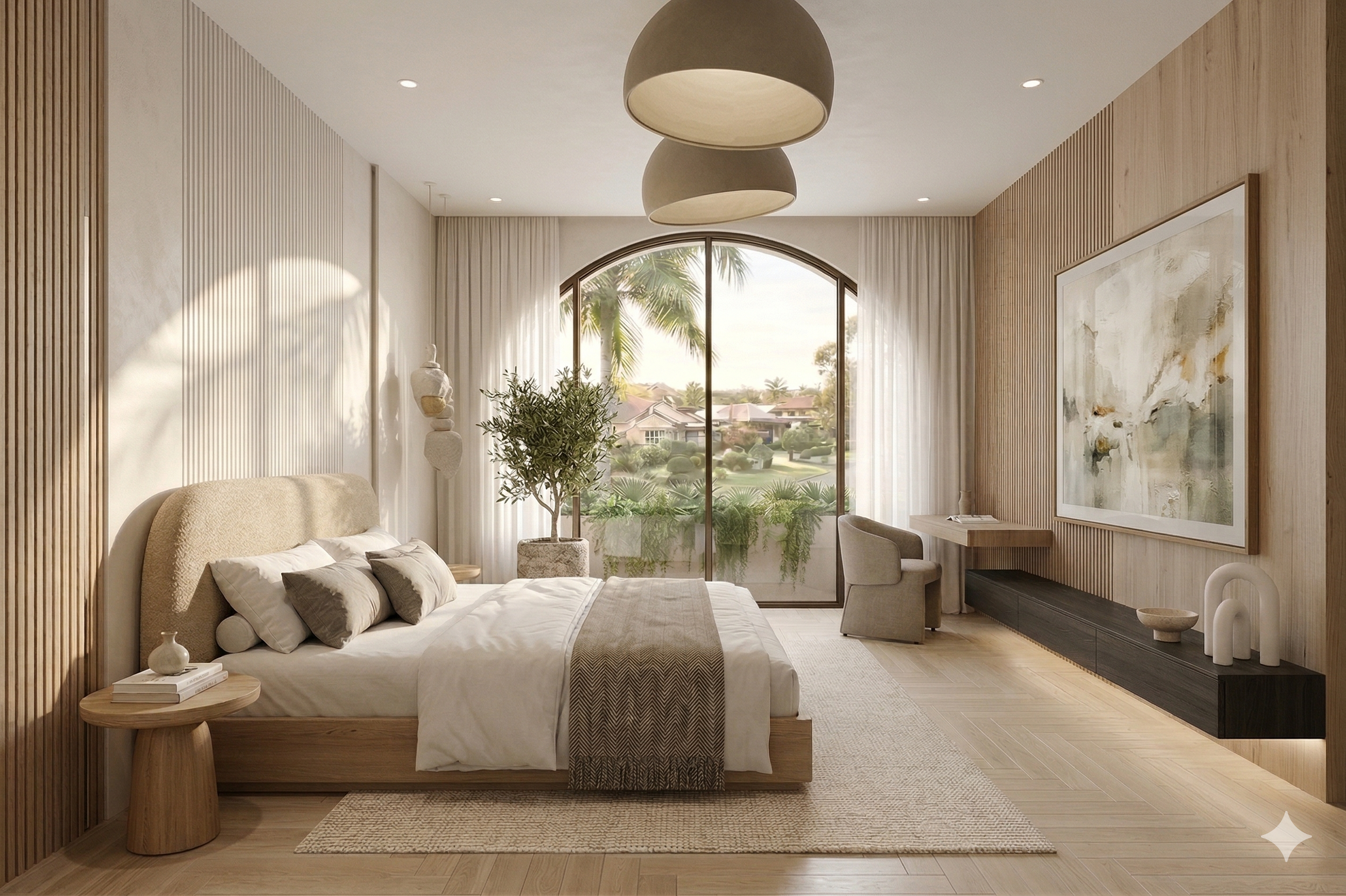
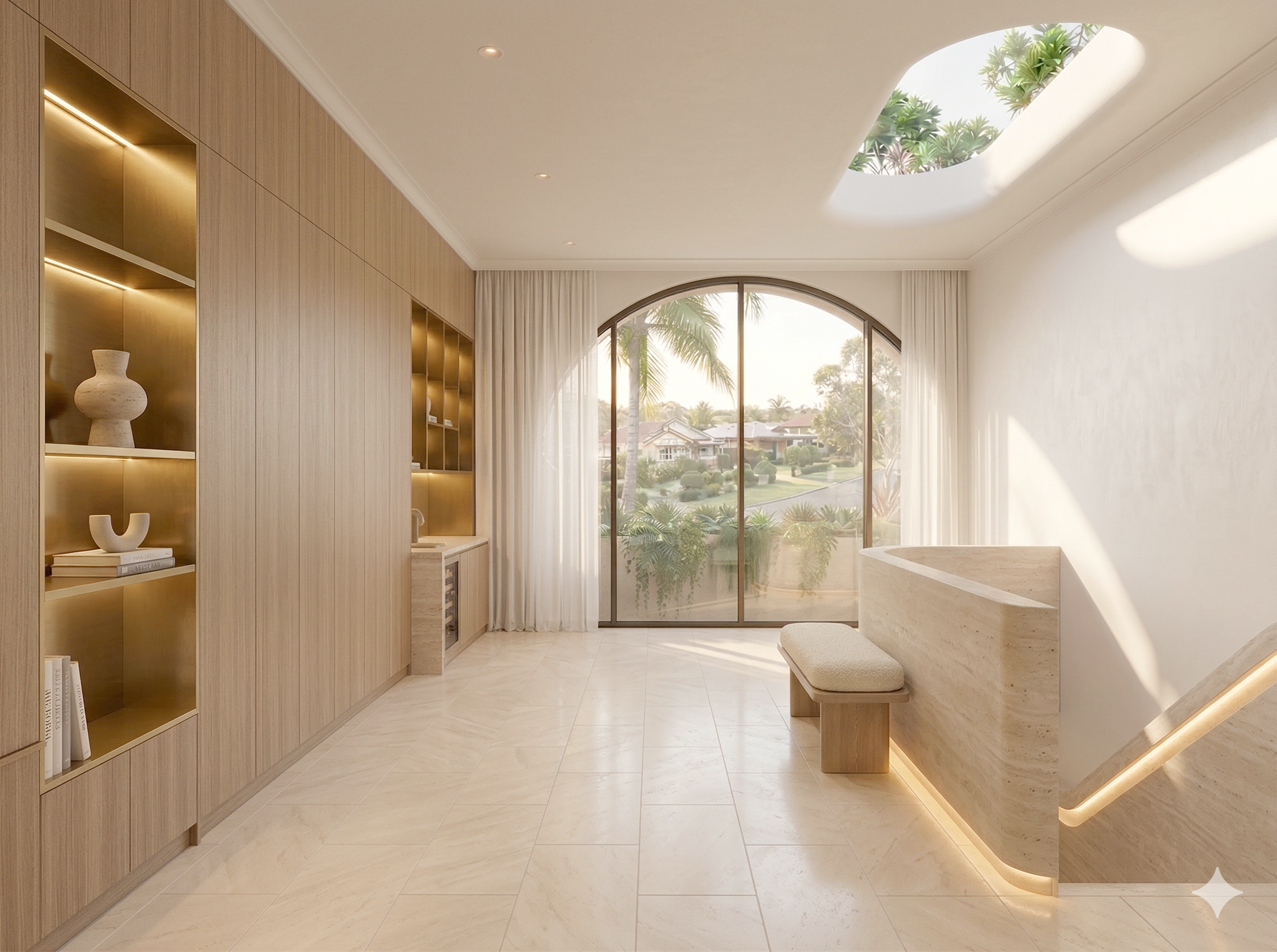
The floor area strategy on a compact site like Shannon Ave depends on discipline. Every design decision either contributes to usable space or consumes it. At Motion 8, our approach to small-site dual occupancy is built around a clear principle: push the section, not the plan. Rather than spreading the footprint to its maximum permissible extent, we worked the vertical dimension — full-height internal volumes at ground level, generous ceiling heights in the primary living areas, and arched openings that borrow light without requiring additional built area.
The shared party wall between the two dwellings is treated as a structural and acoustic asset, not merely a boundary condition. By stacking equivalent rooms across both sides — living above living, bedroom above bedroom — we kept the structural grid clean, reduced the complexity and cost of wet area coordination, and eliminated the need for acoustic separation corridors. The net result is that the floor area delivered to each dwelling is maximised, not trimmed by planning or construction inefficiency.
The garage for each home is fully integrated within the building envelope. This is a decision that costs nothing in design complexity and returns meaningful floor area — area that would otherwise be consumed by an external structure, a setback, or a driveway widening. On a corner lot of this scale, that recovered area makes a real difference to how each home lives.
Materials and Landscape
The material palette is deliberate and restrained. Smooth render in warm off-white is robust and appropriate for the Western Sydney climate, responding well to afternoon light and ageing gracefully with minimal maintenance. The timber garage doors are the primary warmth element at street level, complemented by the planted ledges above. There is no imported stone or decorative cladding for its own sake — every material is doing work.
The landscaping at street level, including the formed garden beds and grass verge, ties the project to its suburban context without being generic. The corner allotment allowed for generous planting on both frontages, giving the building a soft, settled quality even in its completed state. As the planting matures, the building will only improve.
Dual Occupancy in NSW: The Planning Context
For landowners in Greater Sydney exploring whether their site is suitable for a dual occupancy, the planning framework under the Standard Instrument LEP is the starting point. Most dual occupancy developments require a minimum lot size — typically between 450 and 600 square metres depending on the relevant council — and an appropriate residential zoning, most commonly R2 Low Density Residential or R3 Medium Density Residential.
Corner lots like Shannon Ave frequently offer planning advantages beyond their land area. The secondary street frontage can reduce effective setback constraints on one side, increasing the buildable envelope. Where the planning controls allow, a dual occupancy can also be Torrens titled following completion — creating two separate freehold lots, each with its own Certificate of Title. For owner-developers, this Torrens title outcome is often the most significant driver of the project's financial viability, as it transforms a single asset into two independently marketable properties.
Approval can be sought via a Development Application or, where the project meets the prescriptive requirements of the Housing SEPP, through a Complying Development Certificate. The CDC pathway — faster, more predictable, and assessable without a council hearing — is not available to every site, but where it is, it can reduce the approval timeline from many months to a matter of weeks. Motion 8 assesses both pathways for every project at the outset.
The Outcome
The completed project at 12 Shannon Ave is two homes. But it is also, and equally, one building — and that is not always an easy outcome to achieve on a dual occupancy. The facade holds together. The individual addresses feel genuine rather than contrived. And the building sits comfortably on its corner, responding to both street frontages with the kind of confidence that only comes from a resolved design.
For landowners, investors, and owner-developers across Greater Sydney considering whether their site could support a dual occupancy outcome, this project makes the case plainly: a compact corner lot, well designed, delivers more than its dimensions suggest.
Dual Occupancy Design — Motion 8
Motion 8 is a Sydney architectural practice specialising in luxury residential design, dual occupancy, and multi-dwelling development across NSW. We work across the full project lifecycle, from initial site feasibility and planning strategy through to design, documentation, and construction.